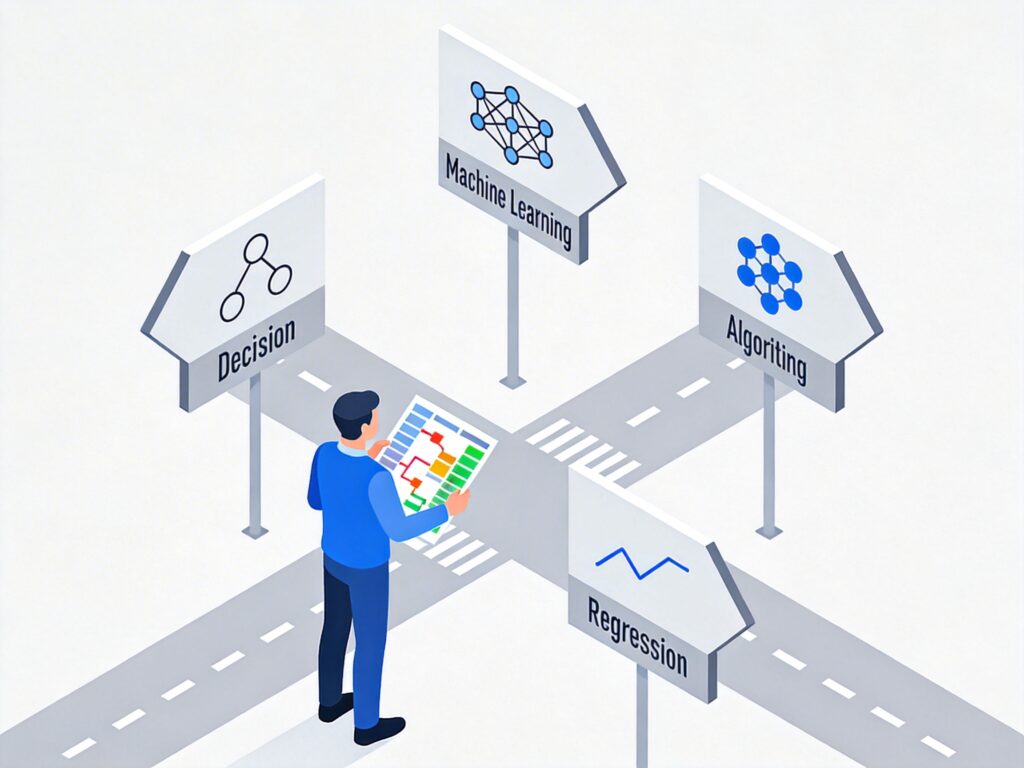
Introduction
This guide is for machine learning enthusiasts, data science beginners, and anyone interested in applying ML algorithms to solve real-world problems. With so many algorithms available, a common question is: "Which one should I use?" The answer depends on several factors:
- Data size, quality, and nature
- Available computational time
- Urgency of the task
- Purpose of the data analysis
Even experienced data scientists often need to test multiple algorithms to find the best performer. While there's no single perfect answer, we can provide a structured approach to narrow down your choices.
Machine Learning Algorithm Cheat Sheet

This cheat sheet helps you quickly filter algorithms suitable for your specific problem. The recommendations are based on compiled feedback from data scientists and ML experts, with simplifications made for beginners.
How to Use the Cheat Sheet
Read the paths as: "If you need <path label>, then use <algorithm>." For example:
- If you need dimensionality reduction, use PCA.
- If you need fast numeric prediction, use Decision Trees or Logistic Regression.
- If you need hierarchical clustering results, use Hierarchical Clustering.
You might match multiple branches or find no perfect match. These are rule-of-thumb suggestions, not absolute rules. The only reliable way to find the best algorithm is often to test several.
Major Categories of Machine Learning Algorithms
Supervised Learning
Algorithms learn from labeled training data to make predictions. You have input variables (features) and an output variable (label) you want to predict.
- Classification: Predicting a discrete class label (e.g., 'cat' or 'dog'). Binary (two classes) or multi-class.
- Regression: Predicting a continuous numerical value.
- Forecasting: Predicting future trends based on historical data.
Semi-Supervised Learning
Uses a small amount of labeled data and a large amount of unlabeled data to improve learning accuracy, addressing the high cost of data labeling.
Unsupervised Learning
Finds hidden patterns or structures in data without labels.
- Clustering: Groups data instances so that similar items are together.
- Dimensionality Reduction: Reduces the number of features while preserving important information.
Reinforcement Learning
An agent learns by interacting with an environment, receiving rewards or penalties for actions. It discovers the best strategy through trial and error to maximize cumulative reward.
Factors to Consider When Choosing an Algorithm
Balance accuracy, training time, and ease of use. Beginners often prioritize algorithms they know or that are easy to implement for a quick initial result. This is a valid starting point. Once you have a baseline, you can invest time in more complex algorithms to improve performance. However, the most accurate algorithms often require careful tuning and significant computational resources.
Choosing Specific Algorithms: Scenarios and Guidance
Linear Regression & Logistic Regression


Linear Regression models a linear relationship between features and a continuous target. Logistic Regression (despite its name) is for classification, estimating the probability of a class.
Linear SVM & Kernel SVM
Support Vector Machines find a hyperplane that best separates classes. The kernel trick maps data to a higher dimension to make non-linear problems separable. For classification with non-numeric targets, Logistic Regression and SVM are excellent first tries due to their simplicity and good performance.
Decision Trees & Ensemble Methods

Decision Trees split the feature space into regions. They are intuitive but prone to overfitting. Random Forests and Gradient Boosting combine many trees to create robust, high-accuracy models that reduce overfitting.
Neural Networks & Deep Learning


Neural networks consist of input, hidden, and output layers. They excel at complex tasks like image and speech recognition. Deep Learning refers to networks with many hidden layers. Advances in computing power (GPUs) and training techniques have driven their success. They can be used for classification, regression, and feature extraction.
K-Means & Gaussian Mixture Models (GMM)


Both partition data into k clusters. K-Means assigns each point to one cluster (hard assignment). GMM gives a probability of belonging to each cluster (soft assignment). Both are fast and simple when k is known.
DBSCAN

DBSCAN groups points based on density. It doesn't require specifying the number of clusters beforehand and can find arbitrarily shaped clusters while identifying noise points.
Hierarchical Clustering

Creates a tree of clusters (dendrogram). You can cut the tree at different levels to get more or fewer clusters, providing flexibility without pre-specifying k.
PCA, SVD & LDA
These are dimensionality reduction techniques. PCA is unsupervised and finds directions of maximum variance. SVD is a related matrix factorization method used in recommendation systems and topic modeling (Latent Semantic Analysis). LDA (Latent Dirichlet Allocation) is a probabilistic model for discovering topics in text documents.
Summary: A Simple Workflow
- Define the Problem: Clearly state what you want to predict or discover.
- Start Simple: Understand your data and build a simple baseline model (e.g., Logistic Regression, Decision Tree).
- Iterate and Complexify: Gradually try more sophisticated algorithms to improve upon your baseline, considering the trade-offs discussed.