Introduction
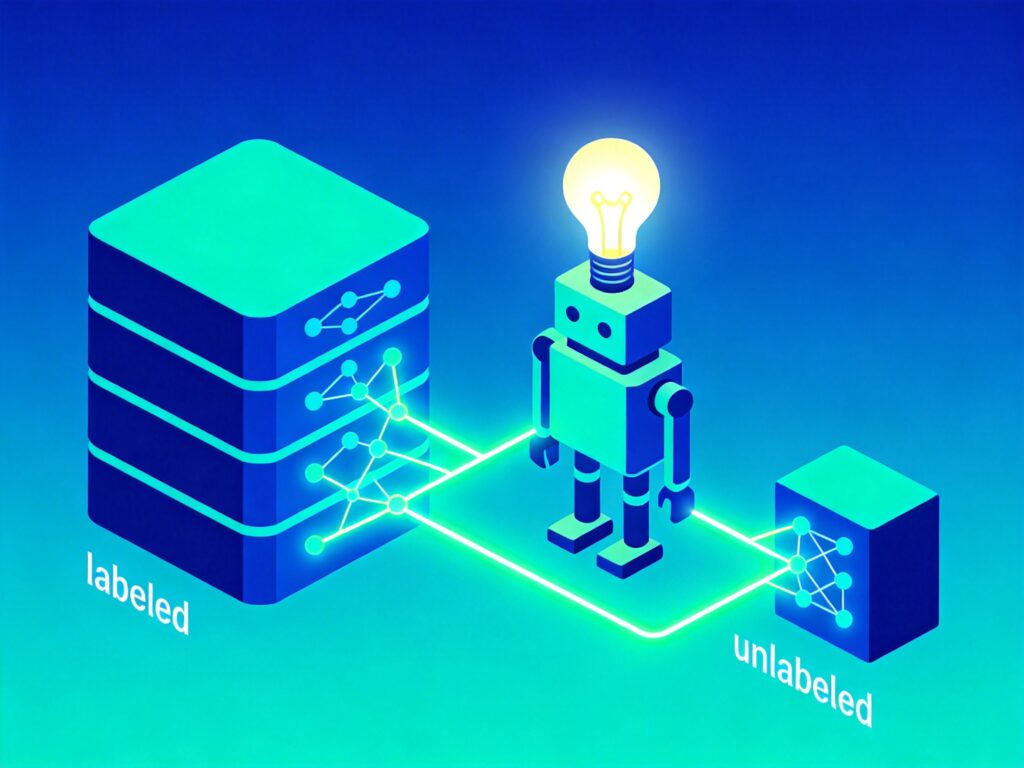
Transfer Learning (TL) is a machine learning technique that enables a model developed for one task to be reused as the starting point for a model on a second, related task. It mirrors the human ability to apply knowledge gained from one domain to another, such as learning to ride a motorcycle more easily after mastering a bicycle.
Traditional machine learning relies on two key assumptions: that training and test data are independently and identically distributed, and that sufficient labeled data is available. In practice, these assumptions often fail. Transfer learning addresses this by leveraging knowledge from a source domain to improve learning in a target domain with limited labeled data, relaxing these strict requirements.
General Definition of Transfer Learning
- Condition: Given a source domain Ds with learning task Ts, and a target domain Dt with learning task Tt.
- Goal: Use knowledge from Ds and Ts to learn the predictive function f(·) for the target domain.
- Constraint: Ds ≠ Dt and/or Ts ≠ Tt.
Categories of Transfer Learning
By Feature Space
- Homogeneous TL: Source and target domains share the same feature space (XS = XT).
- Heterogeneous TL: Source and target domains have different feature spaces (XS ≠ XT).
By Learning Scenario
- Inductive TL: Source and target tasks are different.
- Transductive TL: Domains are different, but the learning task is the same.
- Unsupervised TL: Both domains lack labeled data.
Core Methods of Transfer Learning
1. Instance-based Transfer
Re-weights instances from the source domain that are similar to the target domain, giving them more influence during training. Simple to implement but relies heavily on similarity metrics and weighting schemes.
2. Feature-based Transfer
Transforms data from both domains into a shared feature space where their distributions are aligned. Effective for many problems but can be computationally complex and prone to overfitting.
3. Parameter-based Transfer
Shares or fine-tunes model parameters learned on the source domain for use on the target task. Common in deep learning (e.g., using a pre-trained image classifier). Saves training time but may not converge to the optimal solution for the new task.
4. Relation-based Transfer
Transfers relational knowledge (e.g., social network structures, propagation patterns) from the source to the target domain. Useful when domains share underlying relational logic.
Applications of Transfer Learning
Theoretical Value
- Addresses Data Scarcity: Enables learning when labeled target data is scarce or absent.
- Handles Non-Stationary Environments: Extends classical learning theory to scenarios where data distributions change over time or across domains.
Practical Use Cases
- Robotics: Train policies in simulation (source) and transfer to a physical robot (target).
- Sentiment Analysis: Adapt a model trained on product reviews (source) to analyze video game reviews (target).
- Recommendation Systems: Transfer user preference patterns from a mature movie recommender (source) to a new book recommender (target) to alleviate cold-start problems.
- Dialogue Systems: Fine-tune a general conversational model with small amounts of domain-specific data (e.g., coffee ordering).
- Generative Models: Use GANs to adapt a model trained on one data distribution (e.g., printed fonts) to generate data for another (e.g., handwritten signatures).
Transfer Learning Toolkits
Below are notable toolkits and code resources for transfer learning. Verify links and versions before use.
- Boosting for Transfer Learning (C) – Wenyuan Dai, Qiang Yang et al.
- Selective Transfer Between Learning Tasks (Java) – Eric Eaton and Marie desJardins.
- Domain Adaptation in NLP (C++) – Jiang Jiang.
- Triplex Transfer Learning (Matlab) – Fuzhen Zhuang, Ping Luo et al.
- Heterogeneous Transfer Learning for Image Classification (Matlab) – Yin Zhu, Yuqiang Chen et al.
- Domain Adaptation Toolbox (Matlab) – Ke Yan (GitHub).
References & Further Reading
Sinno Jialin Pan and Qiang Yang, A survey on transfer learning.
Karl Weiss, Taghi M. Khoshgoftaar and DingDing Wang, A survey of transfer learning.
Long Mingsheng, Research on Transfer Learning Problems and Methods.
Note: Some content and conceptual diagrams reference the above materials and related academic reports.