Introduction
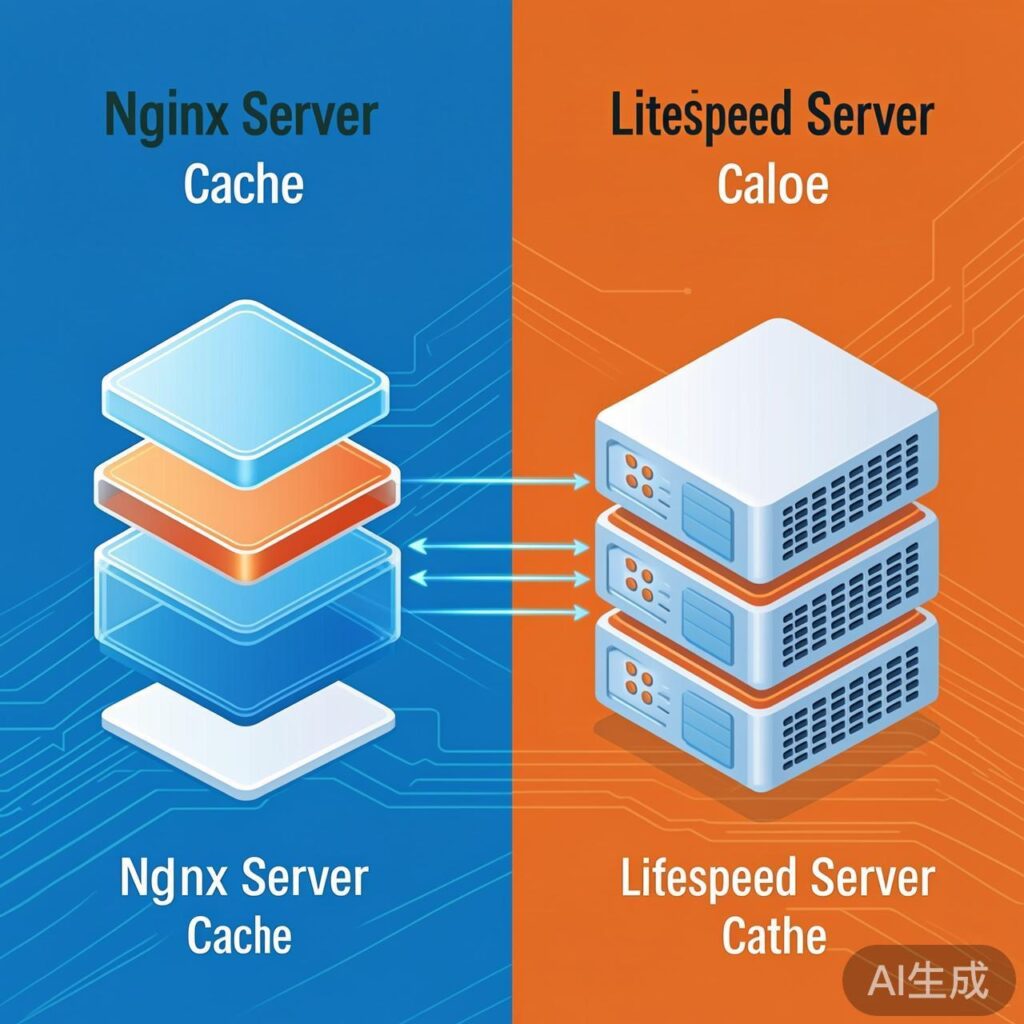
When building high-performance websites, caching is a key technology for improving response speed and reducing server load. Nginx's proxy_cache module and LiteSpeed Web Server's built-in caching technology are two widely used solutions. This article provides an in-depth comparison of both from multiple dimensions including architecture, configuration, performance, and management to help you make the right choice based on your needs.
Nginx proxy_cache Overview
Nginx's proxy_cache is a reverse proxy caching module primarily used to cache responses from upstream servers (like PHP-FPM, Tomcat, or other backend services). It operates at the HTTP layer, storing complete HTTP responses (including headers and body) to disk or memory, and serving them directly for subsequent identical requests without querying the backend again.
Core Features & Configuration
- Disk-based storage: Cache is primarily stored in the filesystem, with configurable paths and hierarchy.
- Flexible cache keys: Complex cache keys (
proxy_cache_key) can be defined, e.g.,$scheme$proxy_host$request_uri. - Cache control: Relies on HTTP headers like
Cache-ControlandExpiresfrom backend responses to determine caching behavior, but can be overridden by Nginx directives likeproxy_cache_valid. - Configuration example:
http {
    proxy_cache_path /path/to/cache levels=1:2 keys_zone=my_cache:10m max_size=10g inactive=60m;
    server {
        location / {
            proxy_pass http://backend;
            proxy_cache my_cache;
            proxy_cache_valid 200 302 10m;
        }
    }
}
LiteSpeed Built-in Caching Overview
LiteSpeed Web Server (LSWS) includes several high-performance caching mechanisms, with LiteSpeed Cache (LSCache) at its core. This is a deeply integrated, server-kernel-level full-page caching solution, with official plugin support for CMS platforms like WordPress, enabling application-level cache awareness.
Core Features
- Kernel-level integration: Caching logic is embedded directly in the server kernel, reducing user/kernel mode switching overhead for high efficiency.
- Application awareness (e.g., WordPress): Through the official LSCache plugin, it understands WordPress page structure, sessions, and personalized content, enabling precise cache purging and conditional caching.
- Hybrid storage: Can utilize both memory (extremely fast) and SSD (high capacity) for caching, automatically managing hot data.
- Instant purge: Provides an efficient tag-based cache purge mechanism, quickly clearing all related cached pages when content is updated.
Key Dimension Comparison
| Dimension | Nginx proxy_cache | LiteSpeed LSCache |
|---|---|---|
| Architecture Level | HTTP reverse proxy layer. Caches backend responses as a proxy server. | Web server kernel layer. Cache is deeply integrated within the server software. |
| Primary Storage | Primarily disk-based files. | Hybrid memory & SSD storage with intelligent tiering. |
| Configuration Complexity | Medium to High. Requires manual configuration of cache paths, keys, validity, and bypass rules. | Low (especially for WordPress). GUI configuration via web admin panel and dedicated plugins. |
| Cache Granularity & Intelligence | Coarser. Based on HTTP request URI and headers, typically unaware of backend application logic. | Finer. Application-aware via plugins (e.g., user login status, shopping cart), supports tag-based caching and purging. |
| Cache Purge Mechanism | Manual cache file deletion or key-based purge via proxy_cache_purge module (requires separate installation). |
Built-in efficient instant purge API, supports purging by tag, prefix, or all, seamlessly integrated with application updates. |
| Performance Profile | Excellent, significantly reduces backend load. Cache lookup involves filesystem operations. | Extreme. Kernel-level operations and memory-first strategy deliver very fast response, typically outperforming Nginx proxy_cache. |
| Ideal Use Case | General-purpose reverse proxy caching for API responses, static backend content, suitable for diverse tech stacks. | Deep optimization for dynamic sites, especially WordPress, Magento, etc., pursuing ultimate performance and management convenience. |
| Cost | Free (open-source Nginx). | LiteSpeed Web Server Enterprise requires a paid license (free edition has limited features). |
Selection Recommendations
Consider Nginx proxy_cache if:
- Your tech stack is already Nginx-based and you want to add a transparent reverse proxy cache layer.
- You need to cache diverse backend services (not limited to PHP) and require highly customizable configuration.
- Budget is limited and you strictly rely on open-source solutions.
- Cached content is relatively simple, without need for complex application-level cache logic and instant purging.
Consider LiteSpeed built-in caching if:
- Your site is primarily based on WordPress, Magento, etc., and you pursue ultimate performance.
- You need very convenient cache management, automatic purging, and fine-grained control, avoiding complex command-line configuration.
- You are willing to invest in web server software for better integration and management tools.
- Site traffic is high, requiring kernel-level efficient cache handling for peak loads.
Conclusion
Nginx proxy_cache is a powerful, flexible, and free reverse proxy caching tool, suitable for generic HTTP caching of various backend services at the infrastructure layer. LiteSpeed's built-in cache (LSCache) is a highly integrated, application-aware, high-performance caching solution, specifically designed to optimize dynamic websites like WordPress, often excelling in ease of use and extreme performance, but requiring a software license fee. The final choice should be based on your specific tech stack, performance requirements, tolerance for management complexity, and project budget.