What is a NoSQL Database?
NoSQL (Not Only SQL) refers to a broad category of non-relational database management systems. Unlike traditional relational databases (RDBMS), NoSQL databases typically do not use a fixed table schema. They are designed to address the demands of modern applications requiring massive scale, high concurrency, and distributed architectures, often making different trade-offs regarding data consistency and transaction support.
Why NoSQL?
The rapid growth of internet and mobile applications has led to an explosion in data volume, concurrent access, and business complexity, challenging traditional relational databases in certain scenarios:
- Scalability: The ACID properties and complex JOIN operations of RDBMS make efficient horizontal scaling across a distributed cluster difficult.
- Data Model Flexibility: Frequent schema modifications during rapid business iteration are costly in relational databases.
- Read/Write Performance: For scenarios involving massive data with high-frequency writes and low-frequency updates (e.g., social feeds, logs), RDBMS optimization is limited.
- Big Data Processing: Storing and processing unstructured or semi-structured data (e.g., JSON documents, graph relationships) is not a core strength of RDBMS.
NoSQL databases emerged to address these needs, characterized by being non-relational, distributed, open-source, and easily scalable horizontally, aiming to provide more flexible, high-performance data storage for large-scale web applications.
Theoretical Foundations
From ACID to CAP/BASE
Relational databases strictly adhere to ACID principles:
- Atomicity: Transactions are all-or-nothing.
- Consistency: The database remains in a valid state before and after a transaction.
- Isolation: Concurrent transactions do not interfere.
- Durability: Committed transactions persist permanently.
To meet distributed, high-availability needs, NoSQL databases are often designed around CAP theorem and BASE theory.
CAP Theorem
CAP states that in a distributed system, you can only guarantee two out of three properties: Consistency (all nodes see the same data), Availability (every request receives a response), and Partition Tolerance (the system continues despite network failures). Since network partitions are inevitable, design choices typically trade off between C and A:
- CP Systems: Prioritize Consistency and Partition Tolerance, potentially sacrificing Availability.
- AP Systems: Prioritize Availability and Partition Tolerance, accepting eventual consistency (common in NoSQL).
BASE Theory
BASE stands for Basically Available, Soft state, Eventually consistent. It's a practical application of the AP direction in CAP, relaxing strong consistency to achieve high scalability and availability.
Main Types of NoSQL Databases
| Type | Characteristics | Examples | Use Cases |
|---|---|---|---|
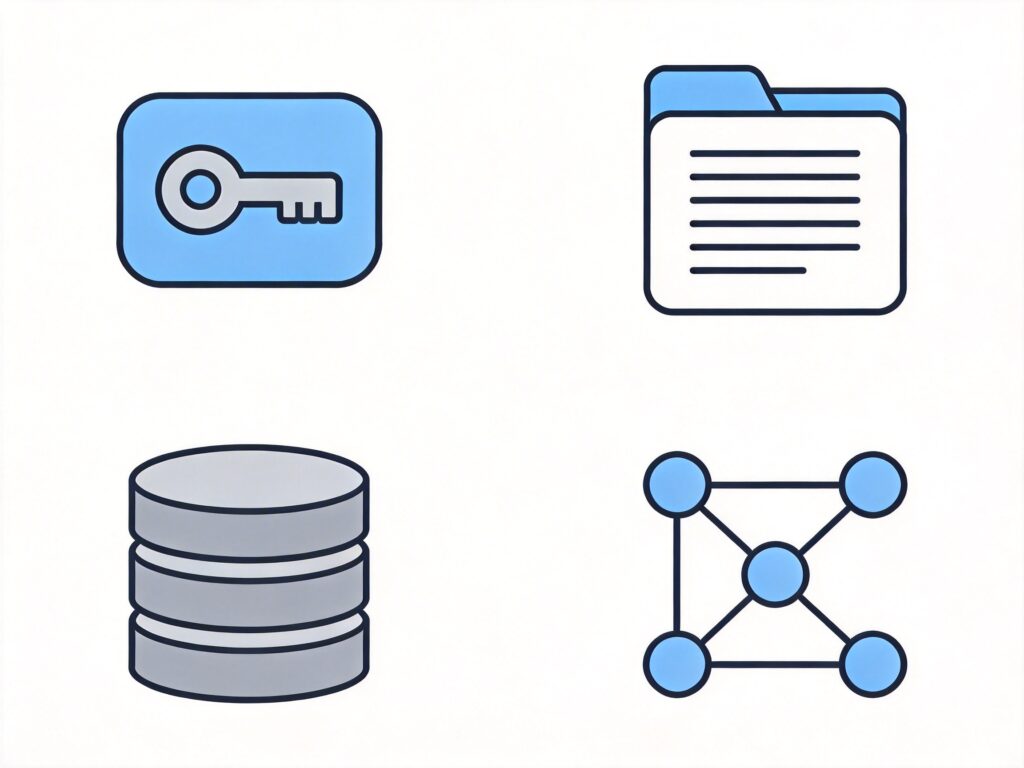
| Key-Value Store | Simple key-based access, high performance. | Redis, DynamoDB | Cache, session store, counters. |
| Document Database | Stores semi-structured documents (JSON/BSON), flexible schema. | MongoDB, CouchDB | Content management, user profiles. |
| Column-Family Store | Data stored by column families, suited for distributed, large-scale data. | Cassandra, HBase | Log analysis, time-series data. |
| Graph Database | Stores nodes and edges, excels at relationship queries. | Neo4j, Amazon Neptune | Social networks, fraud detection. |
Advantages and Disadvantages
Advantages
- High Scalability: Easy horizontal scaling by adding nodes.
- High Performance: Optimized for specific data models and access patterns.
- Flexible Data Model: No predefined schema; adapts to changing structures.
- High Availability: Achieved via distributed architecture and replication.
Disadvantages & Challenges
- Lack of Standardization: Varying interfaces and protocols increase learning curve.
- Limited Transaction Support: Many lack strong cross-document/record ACID transactions (though some, like MongoDB, now support them).
- Simpler Querying: Less powerful and universal than SQL; complex queries may require application logic.
- Ecosystem Maturity: May lag behind RDBMS in management tools and BI support.
NoSQL vs. SQL Comparison
| Feature | Relational (SQL) | NoSQL |
|---|---|---|
| Data Model | Table-based, predefined schema | Flexible (key-value, document, graph) |
| Query Language | Standardized SQL | Proprietary APIs, no standard |
| Scaling | Typically vertical (scale-up) | Easy horizontal (scale-out) |
| Consistency | Strong (ACID) | Often eventual (BASE) |
| Transactions | Full ACID support | Limited, product-dependent |
| Foundation | ACID | CAP, BASE |
Popular NoSQL Databases & Use Cases
1. Redis
Description: In-memory key-value store with persistence and rich data structures.
Use Cases: Caching, session storage, real-time leaderboards, message queues.
Example: Sina Weibo uses Redis for follower lists and hot posts to handle high concurrency.
2. MongoDB
Description: Document-oriented database using BSON, with rich querying and indexing.
Use Cases: Content management, mobile app backends, IoT platforms.
Example Youku migrated some comment services to MongoDB for its flexible schema.
3. Apache Cassandra
Description: Distributed column-family store with no single point of failure, excellent write performance.
Use Cases: Write-heavy apps (logs, sensor data), messaging inboxes.
Example: Apple uses Cassandra for parts of iCloud.
4. Neo4j
Description: Native graph database designed for storing and querying relationships.
Use Cases: Social networks, recommendation engines, fraud detection.
Example: NASA uses Neo4j for spacecraft knowledge graphs.
How to Choose?
Base your choice on business needs, not trends. Consider:
- Data Model: Is data highly relational, key-value, document-based, or graph-like?
- Consistency Requirements: Need strong ACID transactions or okay with eventual consistency?
- Scaling Needs: Expected data/load growth? Need easy horizontal scaling?
- Read/Write Patterns: Read-heavy or write-intensive? Need complex queries?
- Team & Operational Costs: Team expertise? Operational complexity?
In practice, polyglot persistence is common. Use Redis for caching, MySQL for core transactions, Elasticsearch for search, and MongoDB for user content. Combining the right tools for different data patterns is key to building robust systems.