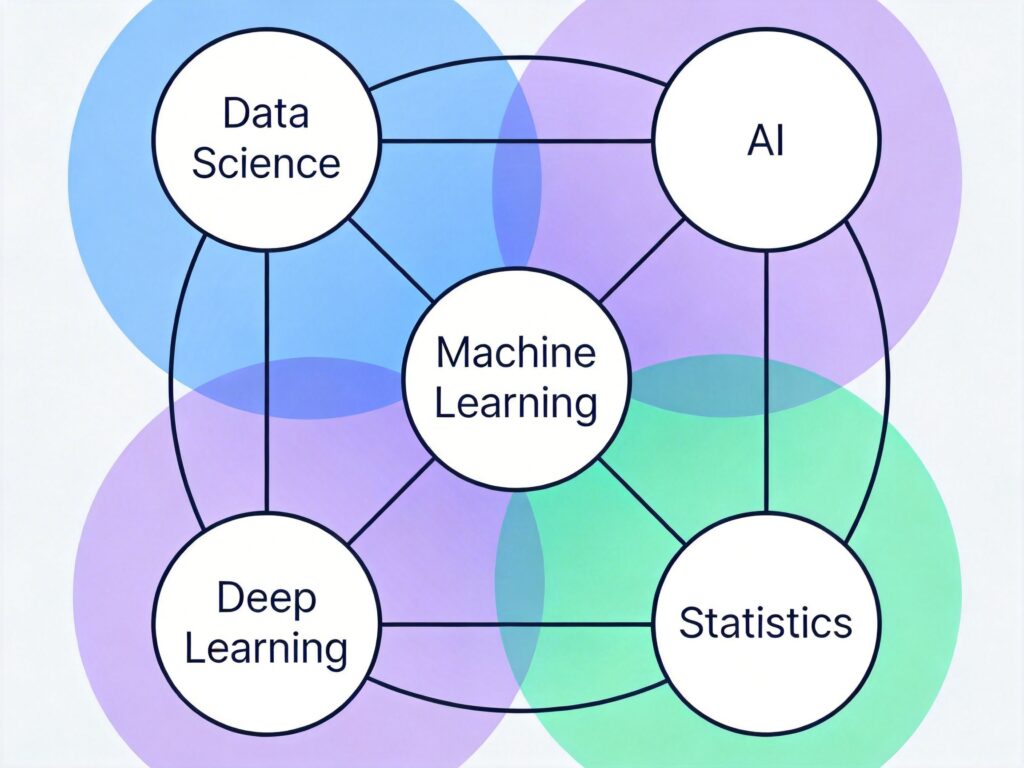
Understanding Data Science, Machine Learning, AI, Deep Learning, and Statistics
Data science is a broad, interdisciplinary field that overlaps with machine learning, deep learning, artificial intelligence, statistics, IoT, operations research, and applied mathematics. This article clarifies the distinctions and connections between these key concepts and outlines the different roles data scientists play in business environments.
1. Different Types of Data Scientists
Data scientist is not a single role. Based on skill focus and job nature, they can be categorized into different types:
- Type A Data Scientist (Analyst): Excels in data analysis, experimental design, predictive modeling, and statistical inference. Their work goes beyond academic statistics' "p-values and confidence intervals" to focus on business insights and decision support. In industry, they may be called statisticians, quantitative analysts, or decision support engineers.
- Type B Data Scientist (Builder): Shares a similar background to Type A but is also a strong programmer or software engineer. They focus on building and deploying data models in production environments, such as recommendation systems, ad targeting, or search engine algorithms.
Additionally, data science roles can encompass data engineers, architects, researchers, and business analysts. In startups, a data scientist often wears multiple hats.
The field of data science is vast, including bioinformatics, computational finance, epidemiology, industrial engineering, and signal processing. With the rise of the Internet of Things (IoT) and machine-to-machine communication, "deep data science" has emerged, handling unstructured data and automated trading systems at the intersection of AI, IoT, and data science.
2. Machine Learning vs. Deep Learning
Machine Learning (ML) is a class of algorithms that learn from data (training sets) to automatically adjust parameters for making predictions or optimizing systems. Common techniques include:
- Supervised Learning (e.g., classification, regression): Logistic Regression, Decision Trees, Support Vector Machines, Naive Bayes.
- Unsupervised Learning (e.g., clustering, dimensionality reduction): K-means, Principal Component Analysis (PCA).
- Ensemble Methods: Random Forest, Gradient Boosting.
Deep Learning (DL) is a subset of machine learning, specifically referring to models using deep neural networks (with multiple hidden layers). It has achieved breakthroughs in computer vision, natural language processing, and other areas. Deep learning models can automatically learn hierarchical feature representations from data.
Artificial Intelligence (AI) is a broader field aiming to enable machines to perform tasks typically requiring human intelligence (e.g., planning, visual recognition, language translation). Machine learning is a primary method for achieving AI. When ML algorithms (especially deep learning) are used to automate complex tasks (like autonomous driving), they are generally considered applications of AI.
3. Machine Learning vs. Statistics
Both statistics and machine learning involve learning from data, but with different emphases:
- Statistics: Focuses more on inference, estimation, and hypothesis testing based on probability theory, emphasizing model interpretability, confidence intervals, and p-values. Traditional statistics often deals with structured, smaller-scale data.
- Machine Learning: Focuses more on prediction accuracy and algorithm generalization, often used for large-scale, high-dimensional data (like images, text). Many ML models (e.g., deep learning) are considered "black boxes" with weaker interpretability.
The boundary is blurring. Modern statistics incorporates ML ideas (like regularization, cross-validation), while ML borrows from statistical inference theory.
4. Data Science vs. Machine Learning
Data Science has a broader scope than Machine Learning. ML (and statistics) are crucial tools in the data science toolkit, but data science covers the entire data lifecycle:
- Data Acquisition & Integration: Collecting, cleaning, and integrating data from various sources.
- Data Storage & Engineering: Designing distributed architectures and data pipelines.
- Exploratory Data Analysis & Visualization: Using charts and dashboards to understand data.
- Modeling & Analysis: Applying statistical methods and machine learning algorithms.
- Deployment & Operations: Putting models into production for automated decision-making.
- Business Intelligence & Decision Support: Translating analytical results into business actions.
In short, data science is an end-to-end process, while machine learning is a core technical component within that process for automated modeling and prediction. Data may come from machines (sensor logs) or non-machine sources (manual surveys), and not all data science activities involve "learning."
Summary of Relationships
The relationship between these fields can be summarized as:
- Artificial Intelligence (AI) is the broadest concept, aiming to create intelligent machines.
- Machine Learning (ML) is a primary approach to achieving AI, enabling machines to learn from data.
- Deep Learning (DL) is a branch of machine learning based on deep neural networks.
- Data Science (DS) is an interdisciplinary field that uses ML, DL, statistics, and other methods to extract insights from data and drive decisions.
- Statistics provides the theoretical foundation and inferential tools for data science and machine learning.
In practice, these fields are highly interconnected. The choice of technology depends on the specific problem, data characteristics, and business goals.