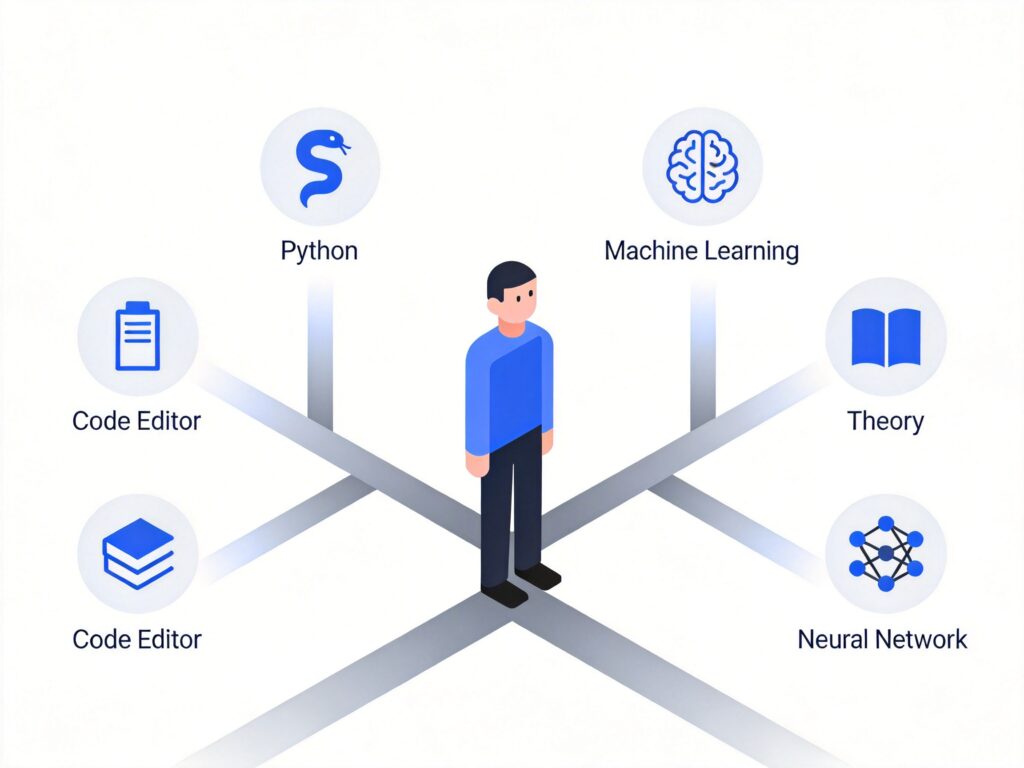
Introduction: Starting Your Python Machine Learning Journey
For beginners, the biggest challenge is often choosing and planning a learning path from the vast array of available resources. This guide provides a clear, actionable roadmap for complete newcomers with little to no background in Python or machine learning, helping you leverage free resources to gradually develop practical skills.
This guide assumes you are not an expert in:
- Machine Learning
- Python Programming
- Python libraries for ML, scientific computing, or data analysis
While some preliminary knowledge of the first two topics is helpful, it's not required; you can catch up during the initial learning phase.
Foundation: Building Core Competencies
Step 1: Master Python Fundamentals
A solid grasp of Python is essential for machine learning. Python is a versatile language widely used in scientific computing, with many excellent beginner resources.
First, install a Python environment. We recommend the Anaconda distribution, which bundles the Python interpreter, core libraries like NumPy, scikit-learn, and Matplotlib, and the Jupyter Notebook interactive environment.
Choose your learning path based on your programming background:
- No Programming Experience: Start with "Learn Python the Hard Way."
- Programming Experience, New to Python: Try Google's Python Course or "Introduction to Python for Scientific Computing."
- Quick Overview: Use a "Learn X in Y Minutes (Python)" tutorial.
- Experienced Python Programmer: You can skip this step but keep the official Python documentation handy.
Step 2: Understand Machine Learning Basics
You don't need a PhD-level theoretical understanding to start. Beginners can build intuition from classic courses.
Andrew Ng's "Machine Learning" course on Coursera is highly recommended. You can study unofficial lecture notes for the core concepts. Tom Mitchell's course videos are also excellent supplementary material.
Don't try to watch all videos and notes at once. A more effective approach is to review relevant theory sections as you progress through practical exercises.
Step 3: Familiarize Yourself with Core Python Scientific Libraries
After learning Python, you need to master the key open-source libraries for ML tasks:
- NumPy: Provides efficient N-dimensional array objects, the foundation for numerical computation.
- Pandas: A powerful data analysis library offering DataFrames and other structures.
- Matplotlib: The primary 2D plotting library for data visualization.
- scikit-learn: The core library covering mainstream machine learning algorithms.
We recommend systematically learning these libraries via "Scipy Lecture Notes" and quickly getting started with Pandas using "10 Minutes to Pandas."
Step 4: Practice Machine Learning with Python
With Python, ML basics, and core library knowledge, you can start practicing with scikit-learn.
First, get familiar with the Jupyter Notebook interactive environment. Then, follow these tutorials in order to build a complete understanding of scikit-learn and the ML workflow:
- Jake VanderPlas's "Introduction to scikit-learn," covering basic usage and the K-Nearest Neighbors algorithm.
- Randal Olson's "Machine Learning with scikit-learn," learning application through a complete project.
- Kevin Markham's tutorial on model evaluation, covering key concepts like train/test splits.
Step 5: Implement Foundational Machine Learning Algorithms
After getting comfortable with scikit-learn, implement some basic, practical algorithms from scratch:
- K-Means Clustering: A classic unsupervised learning algorithm for grouping data.
- Decision Trees: An intuitive, easy-to-understand classification algorithm.
- Linear Regression: A regression algorithm for predicting continuous values.
- Logistic Regression: Despite its name, it's widely used for classification problems.
Step 6: Explore Advanced Machine Learning Algorithms
After mastering the basics, explore more complex models:
- Support Vector Machines (SVM): A powerful non-linear classifier.
- Random Forests: An ensemble learning method based on decision trees with excellent performance. Practice with Kaggle's Titanic project.
- Principal Component Analysis (PCA): A common dimensionality reduction technique for data compression and visualization.
At this point, you'll have learned various algorithms from K-Nearest Neighbors to ensemble methods, along with key skills like model validation and dimensionality reduction.
Step 7: Introduction to Python Deep Learning
Deep learning is at the forefront of machine learning. Start exploring with two major Python deep learning libraries:
- Theano: A library that allows you to define, optimize, and evaluate complex mathematical expressions. Start with Colin Raffel's detailed tutorial.
- Caffe: A deep learning framework emphasizing expression, speed, and modularity. A fun starting point is implementing Google's DeepDream project with Caffe.
For readers seeking a systematic deep learning education, we recommend Michael Nielsen's free online book "Neural Networks and Deep Learning."
Advanced: Deepening and Expanding
If you've completed the foundation section, you can move to the advanced stage, focusing on specific tasks and more sophisticated algorithms.
Step 1: Consolidate Fundamentals and Broaden Perspective
Before diving deeper, review key ML terminology and concepts. In addition to previously mentioned resources, consider:
- Matthew Mayo's "A Machine Learning Glossary."
- Alex Castrounis's "A Complete Overview of Machine Learning."
- Shai Ben-David's video lectures and textbook "Understanding Machine Learning: From Theory to Algorithms."
Step 2: Master More Classification Algorithms
Supplement your classifier knowledge with:
- K-Nearest Neighbors (KNN): A "lazy" classifier with a simple principle.
- Naive Bayes: Based on Bayes' theorem, particularly effective for text classification.
- Multi-layer Perceptron (MLP): A basic feedforward neural network available directly in scikit-learn.
Step 3: Explore More Clustering Algorithms
Beyond K-Means, learn other unsupervised clustering methods:
- Expectation-Maximization (EM) / Gaussian Mixture Models (GMM): A probabilistic clustering method.
- DBSCAN: A density-based clustering algorithm effective at identifying noise points.
Step 4: Deep Dive into Ensemble Methods
Ensemble learning improves performance by combining multiple models. Beyond Random Forests, understand:
- Bagging: Builds multiple models of the same type from different subsets of the training data.
- Boosting: Sequentially builds models, with each new model focusing on correcting the errors of the previous one.
- Voting: Combines predictions from multiple, different types of models.
Step 5: Learn Gradient Boosting
Gradient boosting is one of the most powerful and popular ML algorithms, excelling in competitions like Kaggle. We recommend learning and practicing with the XGBoost library, which provides an efficient and scalable implementation.
Step 6: Delve Deeper into Dimensionality Reduction
Dimensionality reduction includes feature selection and feature extraction. Focus on two feature extraction methods:
- Principal Component Analysis (PCA): An unsupervised linear dimensionality reduction method.
- Linear Discriminant Analysis (LDA): A supervised linear method that aims to maximize class separability.
Step 7: Further Your Deep Learning Studies
To deepen your deep learning knowledge:
- Read explanations of key deep learning terms and concepts.
- Learn to use TensorFlow, a leading deep learning framework. Start with its official tutorials, practicing classic models like Recurrent Neural Networks (RNNs) and Convolutional Neural Networks (CNNs).
Mastery doesn't happen overnight, but by following a structured path and dedicating time to practice, you can systematically acquire the core skills for machine learning with Python and build a solid foundation for exploring more advanced fields.