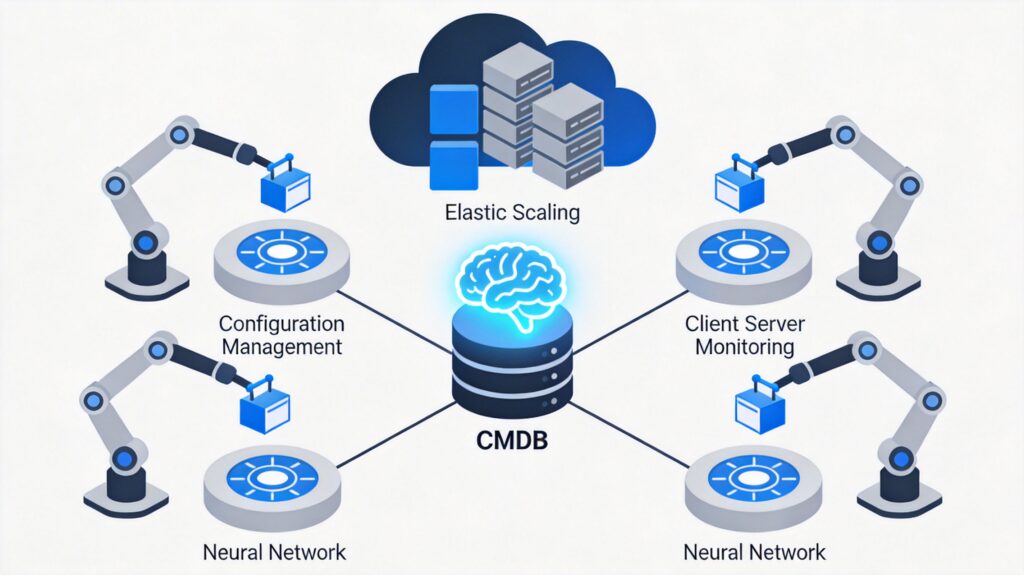
Core Components of an Automated Operations Platform
A complete automated operations platform typically consists of several core components that work together to automate, standardize, and intelligentize operational workflows.
1. Resource Database (CMDB)
The Configuration Management Database (CMDB) is the foundation of the platform. All other functional modules rely on it for accurate, real-time resource information.
Resources are broadly categorized into two main types:
- Physical Resources: Data centers, server rooms, racks, servers, network devices, and other physical hardware.
- Logical/Virtual Resources: Virtual machine instances, containers, IP addresses, domain names, bandwidth quotas, etc.
For internet services, logical/virtual resources directly host the business. For overall enterprise operations, managing physical resources is equally critical and requires integration with backend systems like finance and procurement. Understanding the mapping and relationships between these resource types is key to effective resource governance.
The CMDB also manages all configuration items and their change processes, ensuring data consistency and traceability.
2. Client-Server Monitoring and Feedback System
This system serves as the prerequisite and "sensory system" for automated operations. Its core architecture includes:
- Client (Agent): Deployed on each managed server or virtual machine, responsible for real-time collection of local performance metrics, logs, process status, and other monitoring data.
- Server: Receives data reported from all clients, performs aggregation, analysis, and processing, and persists results to a database.
Based on a request-response model, this system not only provides the data foundation for real-time monitoring and alerting but also serves as the channel for subsequent automated operations like batch task distribution, configuration changes, and status collection. Its stability and performance directly determine the upper limit of the platform's automation capabilities.
3. Business Configuration Management
To handle software configuration differences across various businesses and environments, a unified configuration management solution is needed for automated service deployment and configuration. A typical solution involves establishing two core repositories:
- Software Repository: Similar to a Linux distribution's software source (e.g., Debian's APT, CentOS's YUM), it centrally stores all verified software packages, container images, or binary files.
- Configuration Template Library: Predefines parameterized templates for the same software in different environments (e.g., development, testing, production) or roles. Templates contain dynamically replaceable variables (e.g., database connection addresses, listening ports).
The typical automated workflow is: The task system issues an instruction, the target host first pulls the specified software package from the repository and installs it, then fetches the corresponding configuration template, renders the final configuration file using context (e.g., hostname, environment variables), and deploys it to the specified location. This automates the transition from a "bare metal" state to a "business-ready" state.
4. Elastic Scaling and Cluster Management
This module provides the foundational capability for building modern "cloud" or cloud-native backends and highly depends on the maturity of the previous three components.
- Auto-scaling Out: When monitoring metrics (e.g., CPU, memory, request volume) reach preset thresholds, it automatically requests new resources (VMs/containers) from the resource pool and uses the configuration management module to complete automated deployment and integration of new nodes into the cluster.
- Auto-scaling In: During low-traffic periods, it automatically identifies underutilized resource nodes, safely removes them from the service cluster, and releases them back to the resource pool.
This achieves an optimal balance between resource utilization and business availability, representing a key step towards an intelligent operations platform.
Summary
These four parts form the main framework of an automated operations platform. The CMDB is the "brain," storing all states; the C/S feedback system is the "nerves," collecting and transmitting signals; configuration management is the "muscle," executing specific operations; and elastic scaling is the "advanced reflex," enabling adaptive resource adjustment. Their organic combination is essential for building an efficient, stable, and scalable automated operations system.