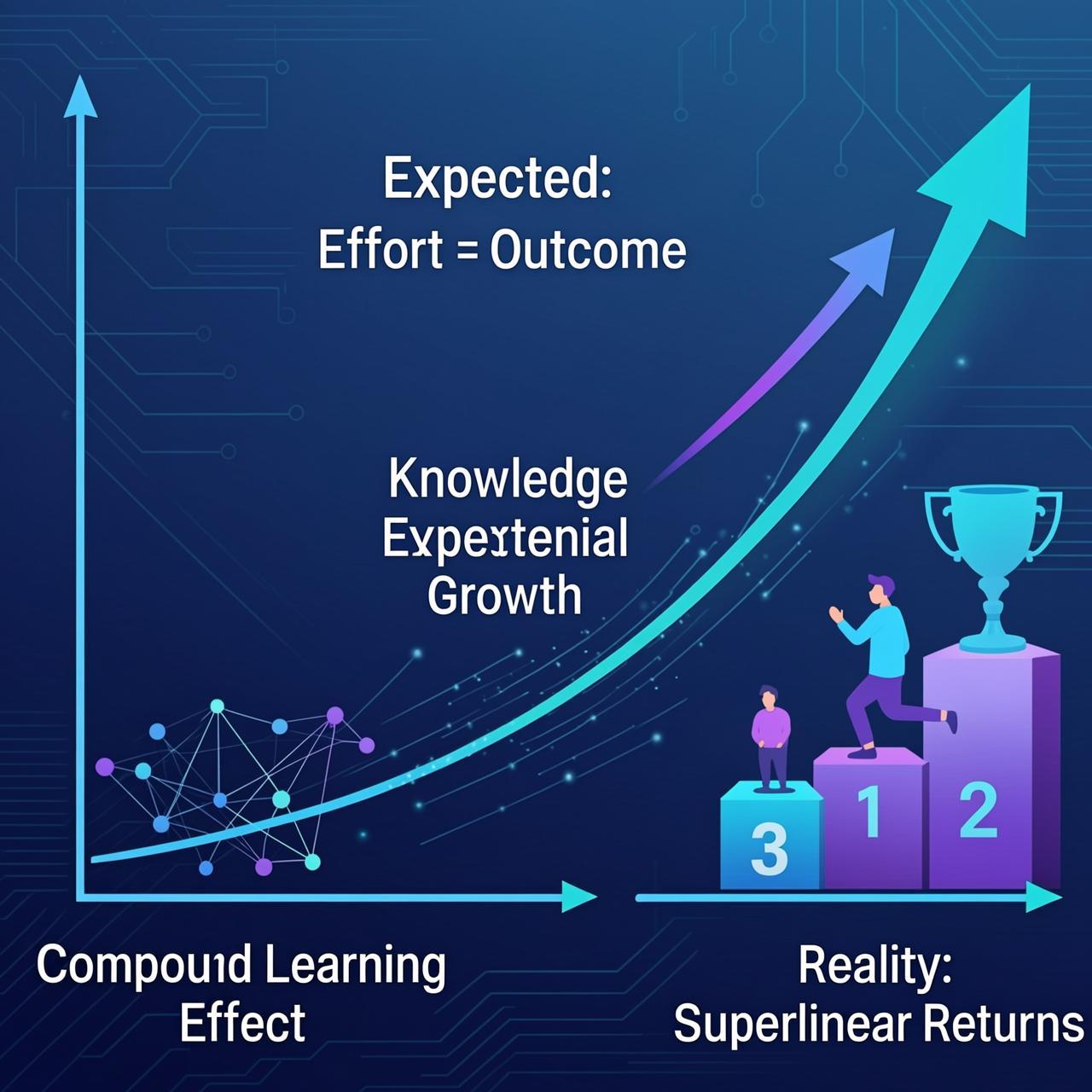
The Non-Linear Nature of Success
Paul Graham's essay "Superlinear Returns" challenges a fundamental assumption we all learned in school: that outcomes are proportional to effort. "You get out what you put in"—this, he argues, is rarely true.
The Two Sources of Superlinear Returns
According to Graham, superlinear returns stem from two root causes:
- Exponential Growth: When your current success feeds future success. Like bacterial growth or startups that scale rapidly.
- Thresholds (Winner-Take-All): When small performance differences lead to dramatically different outcomes. Like in sports or markets with network effects.
Why This Matters for Your Career
The key insight: in knowledge work, the best performers don't just do slightly better—they dominate. The top programmer isn't 10% more productive; they might be 100x more productive because they can solve problems others can't even understand.
"If your product is only half as good as your competitor's, you don't get half as many customers. You get no customers."
The Learning Compounding Effect
Perhaps the most important example: learning itself compounds. The more you know, the easier it is to learn new things. This creates exponential growth—but only if you're constantly learning.
Practical Takeaways
- Seek work that compounds—where doing well today helps you do better tomorrow
- Always be learning—even when you feel like you're failing
- Focus on growth rate, not absolute numbers
- Find your "fractal edge"—the boundary where learning reveals new fields
This essay is essential reading for anyone wanting to understand how success actually works in technology and knowledge work.