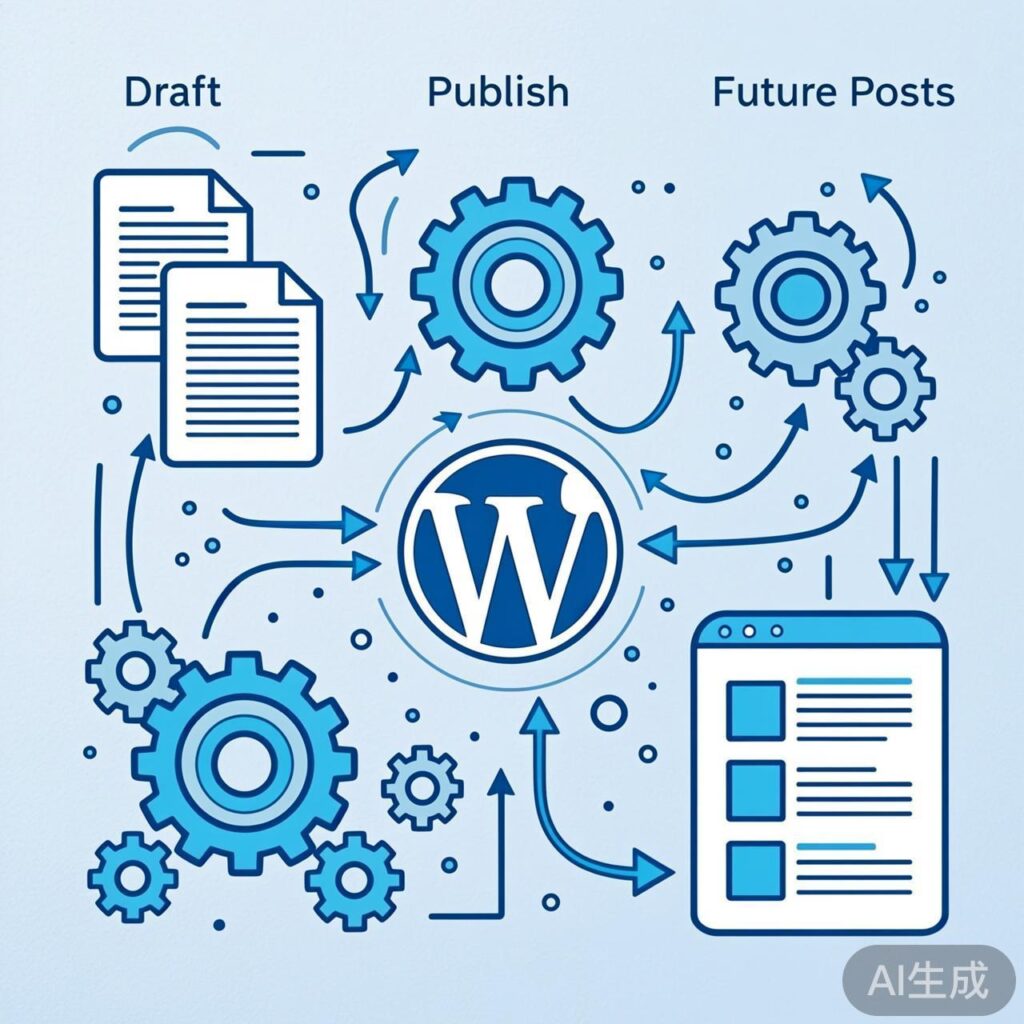
WordPress Content Publishing Hooks Overview
In WordPress development, understanding the various hooks in the content publishing workflow is crucial for implementing custom functionality. Here are several core publishing-related action hooks and their parameter descriptions.
Core Publishing Hooks
- publish_post: Accepts one parameter (
$post_ID). Fires when a post is published by clicking the "Publish" button. - save_post: Accepts one parameter (
$post_ID). Fires when a post is saved (created or updated). - edit_post: Accepts two parameters (
$post_ID,$post). Fires when an existing post is edited. - publish_future_post: Accepts one parameter (
$post_ID). Fires when a scheduled post reaches its set publication time. If the scheduled time is earlier than the current time, it will not fire. - transition_post_status: Accepts three parameters (
$new_status,$old_status,$post). A powerful hook that allows execution of specific actions based on post status changes. - {$old_status}_to_{$new_status}: Accepts one parameter (
$post). This is a dynamic hook for specific status transitions. Examples:draft_to_publish: Handles the event when a post transitions from draft to published status.future_to_publish: Handles the event when a scheduled post transitions to published status.
- post_updated: Accepts three parameters (
$post_ID,$post_after,$post_before). Fires after an existing post has been updated.
Parameter Descriptions
$post: The post object (WP_Post).$post_ID: The post ID (integer).$post_status: Post status string, includingnew,publish,future,draft,pending,private,trash,auto-draft, etc.$post_type: Post type string, includingpost,page,attachment,revision, etc.
Hook Comparison and Selection Guidelines
Based on functional complexity and information availability, these hooks can be roughly ranked as follows:
- post_updated: Most powerful, provides complete post objects before and after changes. Suitable for complex logic requiring historical data comparison.
- transition_post_status: Strong functionality, captures any status change. Ideal for general processing based on status transitions.
- {$old_status}_to_{$new_status}: Most targeted, cleaner code. Suitable for handling specific status transition scenarios.
- publish_post, save_post, edit_post, publish_future_post: Relatively simple and direct. Use when you only need to respond to specific, single events.
Developers should choose the most appropriate and precise hook based on specific business requirements to avoid unnecessary execution and potential performance issues.